The last few weeks have been incredibly busy for the team at The Brain Collective. It feels like the World Has Woken Up to the interdisciplinary landscape which is Neuro Rehabilitation.
Our clinic is not only the first port of call for those struggling with conditions such as stress and insomnia, but also for those with critical conditions such as Traumatic Brain Injury.
The last few weeks have been especially busy as we were asked to speak and exhibit at various events, from the EMG Solicitors’ Annual Conference in Manchester which sought to explore the idea of Imagining a New Era of Brain Injury Support. There we were delighted to present our latest technology, the cloud-based ISync helmet which allows us to map a brain in minutes and take a reading wherever our client may want.
It was a great pleasure to speak at the conference which brought Case Managers, Solicitors and Insurers together to discuss the importance of the emerging support for brain injuries and the notion that there isn’t a one size fits all for these complex cases.
Next, the team exhibited at a conference for the UK’s membership organisation for brain injury & complex case management, (BABICM) which focussed its talks on emerging solutions for Catastrophic Brain Injuries with a conference title of What’s That Coming Over The Hill. We were so proud to be able to share a stand with our friends at Bridge Case Management who have been instrumental in managing so many cases where TBI’s sadly feature.
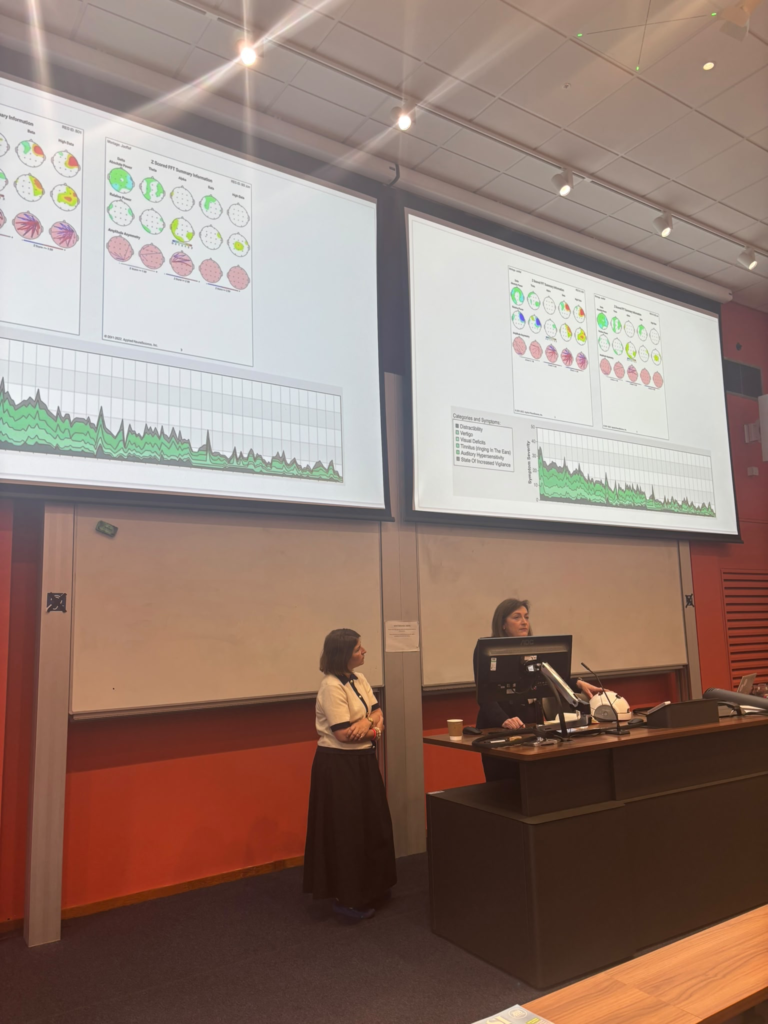
Finally, we received an invitation from a PHD Student at York University a few months ago to speak at an upcoming event, BRAIN Symposium – From Lab to Life: How Technology is Revolutionising Neuroscience Research at the university.
The event would be for BRAIN, a student-led organisation dedicated to Building Relationships Across Interdisciplinary Neuroscience, bringing together students and researchers across psychology, biology, and related fields who share an interest in the brain and its applications.
We presented a talk on Harnessing the power of neuromodulation to optimise brain function in practice and were delighted to share a common love for both EEG and Near Infra-Red Therapies, with various students on the day.
The student-led event highlighted the work of PHD students and traversed a series of topics from Microscopic Tracking to Temporal Interference Stimulation for Alzheimer’s Disease.
Having attended these industry and academic events, we are able to reaffirm that our world is all about embracing technological advances, continuing to deliver as human beings and a multidisciplinary approach is most certainly the way forward.